Expert-authored, case-specific binary rubrics offer a way to carry human judgment across agent runs without asking a universal LLM judge to infer the standard or asking a person to reconstruct it after every run. Meta’s AdvancedIF uses them to test whether a model follows each requirement in a prompt. OpenAI’s HealthBench has physicians write criteria for individual conversations, then tests whether each criterion is met. Scale AI’s ResearchRubrics uses expert-written criteria to evaluate deep research agents and directly compares binary grading with a version that allows partial credit. These are precedents for separating who sets the standard from who decides whether it was met. They do not establish that the separation, on its own, makes a judge reliable on your agent.
An agent can produce a correct final answer after ignoring a constraint or taking an action it had no authority to take. To tell the difference, a reviewer needs the trajectory: the evidence the agent had at key decisions, the choices and actions it recorded, and the resulting state. The choice of evaluator determines who makes sense of that evidence and who sets the standard for the case.
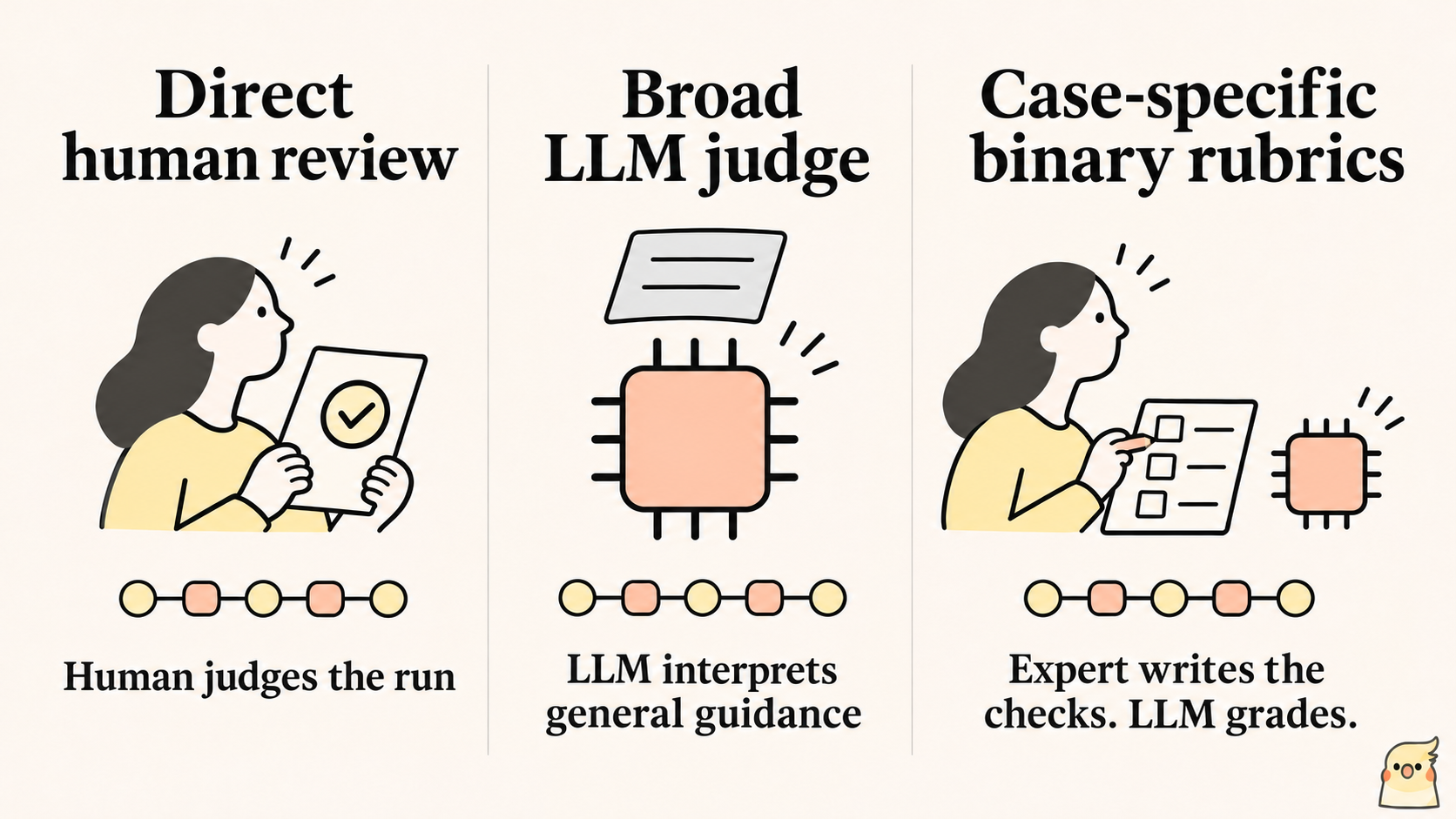
What people author or review, and who judges the run
| Approach | What people author or review | Who judges the run |
|---|---|---|
| One-off human trajectory review | Review the actual decisions, actions, and outcome in a particular run | A human reviewer makes the judgment for that run |
| Broad LLM judge | May write a general prompt or rubric; typically do not review the case’s criteria or expected outcome | An LLM interprets the general standard and grades the run |
| Expert-authored, case-specific binary rubrics | Author pass/fail criteria for the case and specify what evidence supports each verdict | An LLM applies those criteria to the relevant steps and outcome |
Why trust the same LLM with a binary rubric?
A broad judge often has to work out which standard applies, what counts as acceptable, and how much a miss should matter. With a case-specific binary rubric, an expert sets the requirement and specifies what evidence would satisfy it. The model has one narrower job: decide whether the recorded evidence meets that requirement. The yes/no format helps because it puts the threshold in the rubric, rather than asking the model to set it every time it scores a run.
A narrower job can still be done badly. A model can miss an action in the trajectory or return the expected verdict for the wrong reason. If the recorded state answers the question directly, use code. If applying the rubric requires interpretation, check whether the model uses the right evidence, not just whether it returns the right label.
One-off human review: people judge the run directly
Experts can see distinctions a broad judge wasn’t instructed to notice. They can interpret conflicting evidence, recognize when an apparent exception is routine in their field, and explain why they would accept a result but reject how the agent got there. When the team is discovering its standard, or the consequences of getting a decision wrong are high, there is a good reason to look at the actual response with a person.
But a label belongs to the run that was annotated. A correction belongs to that attempt. A reason can travel further, if the reviewer and builder can say when it applies and how another answer could satisfy it. If the review process only stores a verdict or rewrites an answer, the team can end up with a large labeled set and still have to send the next round of outputs back to experts for the same decisions.
There is another cost that is easy to miss: agreement in the labels need not mean agreement in the reasoning. Two experts can reject the same trajectory for different reasons. The difference becomes visible when a new candidate fixes one of those problems but leaves the other in place. If the team never records either requirement, it has not settled whether that candidate is an improvement. More labels can make the aggregate look stable while leaving the disagreement untouched.
I would still use annotations for discovery, judge calibration, and audits. They are particularly valuable when the cases are new, the consequences are high, or something changes in the business. I wouldn’t use them as the default way to repeat judgments the team has already agreed on and can reliably test.
Broad LLM judges: people can set general guidance
A broad LLM judge can start from a human-authored prompt, rubric, or safety policy. What it typically lacks is a human-reviewed standard for each individual case. That makes it useful for observability and, with a defined policy, for live moderation. Production traces show the behavior the system actually delivered, often in situations the team didn’t think to put in its bench. A general quality check can help sift that traffic, surface outputs worth opening, or flag a shift after a model or harness change. You don’t have to settle every domain-specific criterion before you can start looking. The point is to direct attention to the traces that deserve it.
The same class of check can also run during inference. A content moderation check can screen an input or a draft message before it reaches the user, and the application can hold it back or escalate it when the check flags a concern. A generative LLM can make that call, or a decision model can answer a narrower classification question without generating text. Anthropic’s Constitutional Classifiers illustrate how input and output classifiers can apply safety rules during inference. That is a way to enforce a defined safety policy at a particular step. A moderation pass says little about whether the rest of the trajectory followed the business’s rules.
Before calling a change in the broad score a regression, read the traces. The traffic, judge, and system can all change. Check whether comparable runs show a change in the behavior you care about and whether the traces contain the evidence needed to judge it.
When review finds a recurring failure, bring that distinction to the experts. Decide which part of the observed behavior was wrong, when the same expectation should apply, and what evidence the judge would need. Then make it a binary rubric and test it on the relevant situations. Keep the broad monitor running: the new rubric covers a known obligation, while production can still surface things you don’t know to check. A quiet dashboard can’t establish that a requirement was met in a situation that hasn’t occurred.
A broad quality score can be a useful signal, but it is a weak basis for deciding whether to ship. When you ask an LLM for a single score on a scale, the judge has to decide both what went wrong and how much it should count. If the boundary between a 3 and a 4 is unclear, two judgments of the same run can land on different sides of a release threshold. Rating Roulette found that LLM judges could assign different scores to the same inputs across repeated runs. That is not an argument against every rating scale. It is a reason not to let a broad score make a decision the team hasn’t defined.
What makes a binary check worth delegating?
Published benches make that distinction concrete. Meta’s AdvancedIF evaluator illustrates the yes/no question form by checking whether a reply gives exactly two gift ideas, then separately checking their price and whether they repeat earlier suggestions. Scale’s ResearchRubrics input format illustrates the requirement form: one sample criterion asks for brief definitions of specialized terms. In HealthBench, physicians attach a check for an early, explicit referral to emergency care only to conversations where reviewers agree the referral is warranted. The phrasing can vary. What matters is that the criterion tells the judge what to look for, and the case tells it when the criterion applies.
The evidence might be a tool call and its arguments, a state change, or an explanation supported by what the agent actually observed. If that evidence isn’t available, a forced yes/no hides the measurement gap. If the experts haven’t settled what counts, the case belongs back in human review.
What makes the method useful is combining a shared standard with precision where the case needs it. A policy can describe a recurring obligation and when it becomes binding. A case-specific rubric can capture what the obligation means in the situation being tested, including a distinction that the general policy doesn’t settle on its own. Preserve the shared rule so one policy revision doesn’t require rediscovering the rule in each case. Preserve the local check so the evaluator doesn’t have to infer what the expert meant from the broad policy alone.
The specificity is about the obligation, not the wording of an expert’s preferred answer. If different answers satisfy the same obligation, they should remain eligible to pass. A mandatory requirement should have its own result when it can fail independently and would send the builder toward a different fix. A condition that determines when that requirement applies should stay with it. Splitting off the condition can change the policy under test.
This is where expert effort changes: instead of repeating the same verdict on successive candidates, experts define the check and review whether the evaluator applies it as intended.
I would not force every aspect of quality into binary form. When both answers meet the required standard and the team still cares which offers a better experience, a comparison may preserve more of the judgment than a second arbitrary threshold. Keep that preference visible without letting it override a mandatory failure.
When pass/fail checks need gates and weights
Binary rubrics don’t need a scoring system to be useful. Start with a requirement an expert can state clearly and evidence an LLM can inspect reliably. But once several checks apply to a case, a flat pass count can lose something important about the expert’s judgment. Some misses make the entire run unacceptable. Others make it worse without making it unusable. Counting all misses equally treats those as the same; making every check mandatory treats every miss as a blocker.
This is where gates and weights extend binary rubrics. People decide in advance which misses block a pass and what each other check is worth. The LLM only decides whether each applicable criterion was met. It doesn’t set the weights, waive a gate, or assign partial credit. A fixed rule then computes the score. Given the same verdicts and rules, the same case gets the same score. That doesn’t make every verdict repeatable, but it removes the variability of asking the model to decide how much each miss matters. The priorities stay with the people who set them.
AdvancedIF uses prompt-specific criteria and requires all of them to pass. That’s a fit when every instruction is mandatory. HealthBench takes a different approach: physicians assign positive or negative point values to criteria for specific conversations, and the judge decides whether each criterion is met. The points are set by people, not improvised by the judge. A team can also use both approaches: gates for non-negotiable requirements, weights for differences in quality among acceptable runs.
The aggregation rule can’t rescue a check the LLM can’t judge. If recorded system state settles the question, check that state directly. If essential evidence is missing, leave the check unresolved rather than treating it as a pass. And if the distinction still depends on expertise the team hasn’t captured, take the case back to a person. Adding a weight to an unreliable verdict only makes the total look more precise.
In Teammately, a Regime is how a team sets these optional aggregation rules. It’s an extension for cases that need gates, weights, or both, not a prerequisite for using binary rubrics.
What makes reused judgment reliable
Keep three outcomes apart: a rule that does not apply, a rule you cannot assess, and a rule the agent broke. If no case in a slice makes the rule applicable, revisit coverage. If the record cannot establish whether the required action occurred, fix how you observe the run. If the record shows the agent failed to take a required action, fix the behavior. Treating all three as passes or failures loses the diagnosis.
Calibration should protect the decisions that matter. Review confirmed passes and failures with experts, especially around the applicability boundary. Look separately at false passes and false failures rather than relying on an overall agreement rate. A false pass on a release-blocking obligation should not disappear in strong aggregate agreement. A disagreement is also useful diagnostic evidence: the rule may be ambiguous, the material may be incomplete, or the judge may simply have applied a clear rule incorrectly. Sending every disagreement back to prompt tuning conflates those problems.
Keep the individual results available even when the bench reports a summary. If each required check passed somewhere across repeated attempts, those passes may belong to different attempts. The relevant release question is whether the run the product actually relies on meets every applicable mandatory requirement together. Check-level summaries help diagnose what can work; they cannot substitute for evidence about which behavior the customer received.
The method has a maintenance cost. The team has to revise standards as its service changes, keep cases that exercise the changed boundary, and review whether its judges still interpret the evidence correctly. I would compare that effort with the human time spent on repeated review and with the engineering time spent trying to explain a score that didn’t say what broke. A dense rubric is not automatically a better investment. A requirement earns its place when the judgment can change a release decision or point to a distinct repair.
Putting expert-authored binary rubrics to the test
We tested that narrower judging task using 88 synthesized cases across 22 coverage combinations. Each judge received the original input, its context, the candidate response, and the case-specific binary rubric, but not the saved verdict. For the November comparison shown here, each of the 13 models completed one run on the same frozen cases and judging prompt. That lets us compare models on the same task; it does not measure how much a model varies across repeated runs.
We measured two things separately: whether each returned yes/no verdict matched the saved reference (88 comparisons), and whether the explanation met the relevant evidence checks (99 checks). The chart is ordered by the bench’s composite score, not an average of the two displayed rates. In the composite, a failed correctness gate zeros that case; otherwise, the score reflects the weighted share of applicable quality checks that passed.
All 13 models that completed the comparison matched every saved decision. Their rationales passed between 30 and 88 of the 99 evidence checks. If we had looked only at verdicts, all 13 would have looked equally reliable on this task. The rationale checks showed which explanations actually met the evidence requirements and where a matching label could mask a weak explanation.
The labels came from AI-assisted guided contribution sessions. This bench shows how the models performed against that saved standard. It doesn’t establish agreement with independent experts or show that case-specific binary rubrics outperform broad LLM judges and direct human review on the same runs.
Keeping the records separate also made the benchmark’s own checks auditable. In a synthesized refund case from our baseline run, an answer gave instructions to the customer in a section meant for the support agent. The judge returned “no,” as the saved decision expected. A separate correctness check still marked that verdict wrong while citing the same audience error. The two records made it possible to see that the disagreement came from the check of the verdict, not from the judge’s yes/no decision.
Keep the standard with the people who set it
If a bench result will decide what ships, don’t start by picking a more powerful judge. Start with the decisions the team needs to be able to explain. Have experts define which actions and outcomes are acceptable in each case, and decide what evidence would settle them. Use a broad judge to find runs worth inspecting. Use code or an LLM to apply the checks you can verify. Bring new exceptions and disagreements back to the experts rather than asking a model to quietly make a new rule.