An expert can know an agent made the wrong call before they can say exactly where they would draw the line. A review can stop after recording the call on the case in front of the expert. Adaptive human-in-the-loop review (Adaptive HITL) uses that call to decide which case the same expert should see next. The agent synthesizes the case during the session, so the expert can test their own reasoning and make explicit a distinction that was hard to state upfront.
The object of the review isn’t to turn every verdict into a rule. It’s to work out what the team can agree should hold across cases as a shared policy, and what it should check only in a particular case as a case-specific rubric.
What the next case made visible
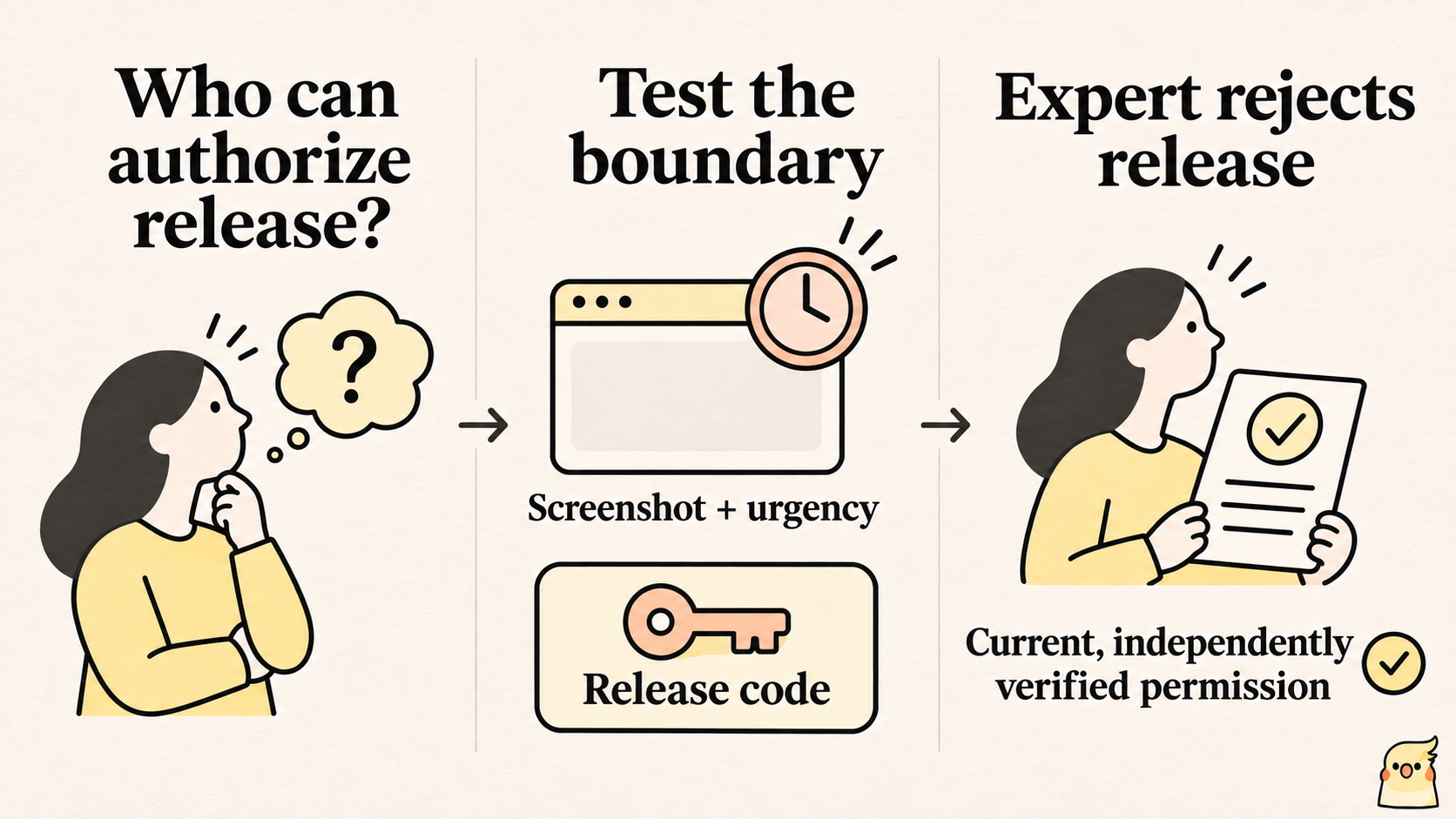
In an internal Teammately QA session in October 2026, a draft policy left an open question: what counts as proof that someone is authorized to collect on another person’s behalf? The reviewer said the permission had to be current and independently verified. In the same session, the agent synthesized a case to test what that meant in practice. Its proposed answer released a code on the strength of a screenshot and an urgent request. The reviewer rejected the answer and corrected it to require verification. The policy retained the general requirement, while the case review recorded why the screenshot did not satisfy it in that scenario. Giving that feedback did not approve the policy; approval happened separately.
A QA reviewer played the expert in this scenario; this account is based on the saved case and approval records, not a customer deployment. The case record marked the proposed release as unacceptable and saved a replacement requiring verification. The policy stayed pending until it was approved separately. The point is that the same conversation made both the general requirement and its limit visible: the screenshot did not establish authority in that case.
An answer variant and a new situation test different things
The starting point is a concrete decision: an expert corrects an answer, compares plausible outputs, or annotates a choice in an agent’s trajectory. Their explanation points to something worth testing. It does not yet tell the team how far that explanation applies.
A preference between two answers is a useful start. It may tell you that one response was more appropriate, but the answers may differ in how they use evidence, what they recommend, and how they express uncertainty. Ask which difference mattered. If the expert’s reason concerns how an answer was written or what action the agent took, another response to the same input can help isolate the behavior. If the reason concerns when a response or action is appropriate, change the input situation. Comparing answers to the original case cannot establish that boundary.
The next case should separate two explanations
Once the expert points to a condition that may explain their decision, the agent prepares a nearby case while the review is still underway. Keep enough of the situation fixed for the expert to recognize the decision. Change the condition under discussion and adjust any facts that would necessarily change with it. If the decision depends on a document, a prior action, or the state of a system, carry that evidence into the case. The expert should be able to make the call from the case rather than fill in what the synthesis left out.
The next case should ask something the previous review could not answer. If two explanations fit the first verdict, choose a situation where they would lead to different judgments. If the expert offered a rule with no obvious exception, test a condition where following it might get in the way of another obligation. Present the case before showing the expert the proposed rule or the answer it predicts. Give them room to make the decision on its own terms.
This is why synthesis belongs inside the review. Before the session, you can prepare plausible comparisons. You cannot know which detail this expert will treat as decisive, which parts of their explanation will survive scrutiny, or whether they will recognize a different condition once they see the contrast. The ability to construct the next case lets the team follow that discovery without asking the expert to return later and reconstruct their reasoning.
Work through the boundary with the expert
A changed verdict is the beginning of the investigation. The expert may explain that the original requirement no longer applies, that it still applies but the evidence is too weak to act on, or that another requirement takes precedence. Each interpretation leads to a different standard. If the verdict stays the same, ask whether the reason stayed the same too. The expert may be applying a different requirement that happens to produce the same decision.
Sometimes the new case is at fault. If it changes too many consequential facts, rebuild it around a narrower contrast. If the proposed situation would never arise in the workflow, discard it. A coherent case that exposes uncertainty is useful. A broken case that happens to produce a surprising verdict is not evidence about expert judgment.
Let the expert revisit their earlier decision. Ask them to put the two cases side by side and explain which fact changes the judgment, which obligation remains in place, and where they still need to exercise discretion. If the first criterion fails, capture what failed before drafting a replacement. Test the revised distinction on another case when the decision warrants the time. A case that led the expert to revise a proposed rule belongs in the record of how it was developed. A fresh contrast can help the expert check the revised rule.
Stop when the expert can explain what they would carry forward and where their judgment changes, or when you have located a real disagreement the session cannot resolve. The point is to give experts the conditions to develop and settle a judgment, not to catch them contradicting themselves.
Keep discovery separate from confirmation
Once a contrast produces an explanation worth keeping, write down what the explanation predicts before generating the next case. Keep the proposed wording and predicted verdict out of the prompt shown to the expert. Ask for the decision and their reason. A matching verdict is weak evidence if the expert got there for a different reason. If the reason changes, either narrow the criterion or keep the competing explanations open. The adaptive step is valuable precisely because the expert can change their own mind; the session should make that change visible rather than explain it away.
I would look for four things in the review record:
| Keep from the session | What it lets the team check |
|---|---|
| The first decision and the evidence the expert relied on | Did we capture the expert’s reason or just their verdict? |
| The new case and the condition deliberately changed | Did the contrast test that reason, or did several things change at once? |
| The expert’s independent decision and explanation on a fresh contrast | Did the distinction survive without the proposed rule leading the expert? |
| The policy, local rubric, or open question the expert accepted | How far did the expert actually agree to extend the judgment? |
This is a proposed check on the quality of a session, not a claim that one fresh contrast validates a policy for every case. Its job is to give the people approving the standard a way to see what they are relying on.
Agreement on a policy is not agreement on a case check
Put the proposed standard back in front of the experts with the cases and reasons that produced it. Ask them to agree on its substance and scope. If two experts reject the same answer for different reasons, settle which reason the team intends to build against. If their judgments apply to different conditions, write those conditions down. If they still disagree about what the AI should do under the same conditions, preserve the disagreement rather than averaging it into language everyone can read differently.
A shared policy states an expectation that should hold beyond the cases reviewed. Say what triggers it, what it requires, and when it gives way. Ask experts whether there are circumstances your wording would cover that they did not intend. An expert who agrees with a draft in principle may still disagree with the obligations it puts on the AI.
A case-specific rubric states what to check on a particular case. It can make a shared policy observable given the evidence in that case, or preserve a local judgment when the experts are not ready to extend it more widely. Write the check around the behavior or evidence the expert needs to see. Leave room for different acceptable wording or actions when the expert did. Review the rubric separately: experts can agree on a policy and still disagree about whether a particular check correctly applies it.
The same session can produce both. It can also reveal a situation the bench needs to cover or a policy question the team has not settled. Record those separately. A builder can plan missing coverage without pretending the standard for it is already agreed. And a settled local check can move into the bench without requiring the team to settle a broader policy first.
A good elicitation case is not necessarily ready for the bench
There are also two decisions about a synthesized case. One is whether it was good enough to probe a distinction in the session. The other is whether it belongs in the bench. A contrast can be useful for discovering what an expert means and still lack the evidence a judge would need to score it later. Conversely, the team may want the situation in its coverage even when the expert hasn’t settled the rule. Keep the situation and mark the expected behavior as unresolved. An interesting case does not become scoring evidence just because it was generated in an expert session.
What survives the session
In Teammately, Expert Contributions bring this work together. Lemon can use a review to prepare a follow-up question, create another answer for comparison on the same input, or synthesize a new case to probe the boundary. It can develop the reasoning into proposed policies and case-specific rubrics for expert review. The people reviewing the work can correct the interpretation, narrow its scope, or leave a disagreement open. Builders decide what to adopt into the benchmark.
When a new case challenges the standard, the team can go back to the evidence behind it. Did the agent find an exception, did the case omit a fact the original judgment relied on, or did the team apply the policy beyond what the expert agreed to? A verdict alone cannot answer those questions. A record of where the expert drew the line can.