# Expert UI
Generated: 2026-09-13T04:39:32.536Z
Source build: local
Canonical docs: https://teammately.ai/docs
---
id: integrations.reviewer-workspace
title: Expert UI
summary: Understand how experts receive assigned work and how expert-facing tasks, interviews, and checkpoints fit into Teammately.
kind: concept
product_area: expert_contributions
status: stable
updated: 2026-09-07
canonical: /docs/integrations/reviewer-workspace
---
# Expert UI
## Definition
Expert UI is the reviewer-facing experience for completing assigned Expert Contribution work. The main Teammately product defines the Contribution, selected benchmark context, intended expert, tasks, and Checkpoints. Expert UI presents the executable activities—such as structured questions, Case review, or an interview—and returns attributable answers and artifacts to that Contribution.
It is not a second correctness-governance workspace. Experts contribute judgment in context; project operators use the main product to inspect Contribution state and reconcile accepted learning into Cases, Policies, Rubrics, or coverage observations.
## Why it matters
Scarce specialists should not have to reconstruct the project or navigate the full benchmark workspace. The assignment packages the relevant Cases, sources, questions, and reason for asking. Keeping the resulting answers attached to task, session, expert, and Checkpoint identity makes later materialization explainable without turning every interaction into approved truth.
## Where it appears in the product
Experts enter through the reviewer-facing route supplied by an assignment. Runtime navigation selects the current executable task and preserves resume or terminal behavior. In the main product, **Expert Contributions** shows preparation, alignment, task materialization, assigned work, progress, Checkpoints, logs, and contributed artifacts.
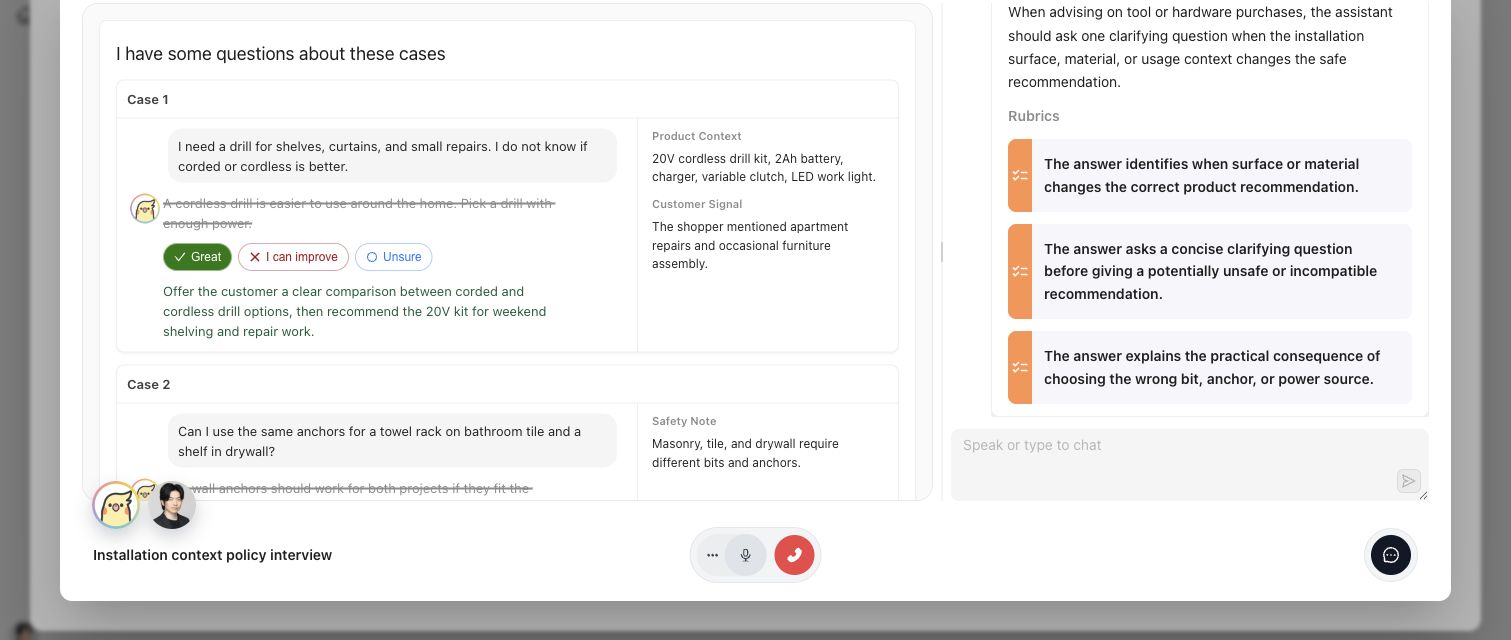
Expert UI keeps the Case, requested judgment, rationale, and relevant standards visible in one assigned activity.
## Artifacts it affects
An executable task contract identifies the Contribution and activity, presentation type, questions or Case context, allowed responses, and completion boundary. An expert answer can include rationale and suggested changes, but it is not automatically an approved Policy, Rubric, Case-scoped reference output, or Benchmark Dataset membership decision. Checkpoint and materialization state must be read from the owning Contribution.
## Operational check
Confirm that the expert is in the intended Project, the assignment opens the correct Contribution, the current activity displays the required source context, and submission reaches the expected completion or Checkpoint state. If the expert cannot answer from the supplied evidence, record that limitation rather than forcing a definitive judgment.
{% example-demo title="Interview returning governed learning" %}
A procurement specialist opens an assigned interview containing three Cases with conflicting source documents. The specialist explains which source controls, qualifies one unresolved exception, and confirms the proposed rule at a Checkpoint. Expert UI returns the attributed answers and state. In the main product, the Contribution materializes a Policy candidate and a coverage observation; neither becomes governed merely because the interview ended.
{% /example-demo %}
## Related workflows
{% related-card-grid title="Related workflows" %}
- [Correctness Elicitation](/docs/concepts/correctness-elicitation)
- [Expert Contributions](/docs/expert-contributions)
- [Complete an Expert Contribution](/docs/expert-contributions/complete-contribution)
- [Contribution Lifecycle and Status](/docs/expert-contributions/lifecycle-and-status)
- [Product quickstart](/docs/quickstart)
- [Task index](/docs/operating-manual/task-index)
{% /related-card-grid %}
## Source confidence
Code-backed: the main-product Contribution route and Review Screen establish assignment context, while the Expert UI executable-task and runtime-navigation contracts establish activity presentation, progression, resume, and terminal behavior. Linked Contribution pages define approval and materialization boundaries.
---
id: concepts.correctness-elicitation
title: Correctness Elicitation
summary: Turn tacit specialist judgment into attributable contributions, governed policies, applicability conditions, and binary rubrics.
kind: concept
product_area: correctness_elicitation
status: stable
updated: 2026-09-07
canonical: /docs/concepts/correctness-elicitation
---
# Correctness Elicitation
Correctness Elicitation is the capability for turning specialist judgment into explicit, reusable correctness specifications. It handles the parts of AI behavior that cannot be settled by a generic score: domain preferences, exceptions, conflicts between sources, applicability boundaries, unacceptable failure modes, and the evidence an expert needs before making a decision.
## Definition
Elicitation begins before the expert opens a task. Teammately agents can organize relevant Reference Materials, cases, candidate responses, possible policies, rubric questions, and unresolved conflicts into a focused Contribution. The expert then works through forms, chat, interviews, case review, or checkpoints according to the requested components.
The contribution remains attributable. Accepted learning can be materialized into policies, rubrics, cases, or coverage observations, while drafts and unresolved statements keep their own state. Correctness Governance owns the resulting policies and rubrics; Expert Contributions owns the benchmark-scoped human work that produced them.
## Decision checkpoint
| Need | Elicitation method | Durable destination |
| --- | --- | --- |
| Confirm a known rule across several cases | Focused form or case review | Policy, applicability, or rubric contribution |
| Discover reasoning that is hard to pre-structure | Chat or interview | Attributable transcript, checkpoints, and contributed artifacts |
| Resolve disagreement or ambiguity | Targeted comparison and checkpoint | Explicit unresolved or accepted statement |
| Identify missing benchmark behavior | Cases plus coverage questions | Contributed case or coverage observation |
| Configure reviewer presentation | Assets → Review Screens | Reusable Review Screen |
| Set a contribution's agent behavior | Expert Contribution | Contribution behavior and selected components |
## Why preparation matters
An expert should not have to reconstruct the project, search for the controlling source, or infer why a case was selected. Project Context gives the agent the stable brief. Reference Materials provide indexed project knowledge. The Contribution selects the benchmark evidence, states the objective, and configures agent behavior. Review Screen controls presentation.
This separation preserves authority. Reference material can inform an answer without becoming a policy. Agent-authored draft wording can focus the expert without becoming approved. A completed expert task can contribute evidence without automatically changing every project artifact.
## Relationship to the product
Correctness Elicitation is broader than any single screen. Use **Expert Contributions** to request and track benchmark-scoped expert work. Use **Correctness Governance** to inspect and maintain policies and rubrics after they are materialized. Use **Agent Setup** to configure what agents understand, **Assets → Review Screens** for reusable expert-facing presentation, and the Contribution itself for scoped behavior and components.
The capability also returns learning to Coverage Engineering and Weave. An expert may identify a missing behavior combination, contribute a new case, or explain that existing material is insufficient. Those outputs should update the owning coverage or case artifacts instead of being flattened into a general review note.
{% example-demo title="Exception handling" %}
An agent prepares three cases where a procurement rule might allow an exception, attaches the controlling policy material, and asks a specialist to distinguish approved exceptions from escalation-only situations. The specialist completes a case review and confirms a checkpoint. The accepted contribution materializes a scoped policy and binary rubric, while one unresolved source conflict becomes a coverage observation for follow-up.
{% /example-demo %}
## Related workflows
{% related-card-grid title="Related workflows" %}
- [Request an Expert Contribution](/docs/expert-contributions/request-contribution)
- [Manage policies and rubrics](/docs/correctness-governance)
- [Configure Agent Setup](/docs/agent-setup)
{% /related-card-grid %}
## Related reference pages
{% related-card-grid title="Related reference pages" %}
- [Human Approval Boundaries](/docs/governance/human-approval-boundaries)
- [Policies](/docs/object-model/policies)
- [Rubrics](/docs/object-model/rubrics)
{% /related-card-grid %}
## Source confidence
Doctrine-backed: this page defines the public capability. The linked product pages are code-backed and define the active contribution, governance, and agent-configuration surfaces.
---
id: expert-contributions.overview
title: Expert Contributions
summary: Coordinate benchmark-scoped expert work, attributable judgment, governed artifacts, and the decisions that move correctness forward.
kind: concept
product_area: expert_contributions
status: stable
updated: 2026-09-07
canonical: /docs/expert-contributions
---
# Expert Contributions
Expert Contributions is the benchmark-scoped workspace for requesting, conducting, and materializing specialist work. It coordinates the expert, objective, selected evidence, task sequence, checkpoints, attributable responses, and contributed artifacts needed to move a benchmark forward.
## Definition
The administrator workspace contains **Overview**, **Contributions**, **Contributed Artifacts**, and **Logs & Status**. **Request Contribution** opens the composer for a new contribution. The expert follows a contribution-specific experience that can contain form, chat, interview, and case-review tasks, along with checkpoints and completion states.
A Contribution is the unit of requested expert effort. It replaces broad workflow configuration with a bounded statement of what this benchmark needs from this expert now. The work can result in contributed policies, rubrics, cases, or coverage observations without flattening all expert activity into one generic approval record.
## Decision checkpoint
| Need | Contribution element | Result to inspect |
| --- | --- | --- |
| Resolve a specific benchmark question | Contribution statement and scoped objectives | The expert can explain the requested decision |
| Ground work in concrete behavior | Selected or designated cases | Case-level responses remain attributable |
| Supply supporting knowledge | Attachments and scoped statements | The expert sees the relevant source boundary |
| Choose the right interaction | Form, chat, interview, or case review task | Task output matches the kind of judgment needed |
| Confirm consequential learning | Checkpoint | Accepted, revised, or unresolved state is explicit |
| Reuse the result | Contributed Artifacts | Policies, rubrics, cases, and coverage observations retain provenance |
## Lifecycle and status
The durable Contribution statuses are `PREPARING_DIRECTION`, `AWAITING_DIRECTION_ALIGNMENT`, `MATERIALIZING_TASKS`, `READY`, `IN_PROGRESS`, `COMPLETED`, and `CANCELLED`. The interface presents these as planning direction, waiting for alignment, preparing tasks, ready, active, completed, or cancelled. The exact task sequence can vary by Contribution.
Realtime updates and durable transitions help the administrator and expert see current progress without inventing completion. A waiting state, checkpoint, or finalization step should be shown as such. Completing the expert experience does not imply that every proposed artifact has been accepted into its project-level owner.
## Contribution evidence
Logs & Status exposes operational and engagement records. Contributed Artifacts organizes materialized or contributed cases, policies, rubrics, and new coverage observations. Correctness Governance, Assets, or Coverage Management owns the resulting project or benchmark artifact after materialization.
This model improves return on expert effort. Agents prepare focused work from project context, indexed material, benchmark cases, and unresolved questions. The expert supplies the authority; the result can be reused across standards, coverage, evaluation, and improvement.
{% example-demo title="Resolve source authority" %}
A benchmark contains cases where an operational runbook conflicts with a newer policy page. The operator requests a Contribution from the policy owner, selects the conflicting cases, attaches both sources, and uses case review plus a checkpoint. The expert establishes which source controls, contributes a scoped policy and rubric, and records one coverage observation for an unrepresented exception.
{% /example-demo %}
## Related workflows
{% related-card-grid title="Related workflows" %}
- [Request an Expert Contribution](/docs/expert-contributions/request-contribution)
- [Complete an Expert Contribution](/docs/expert-contributions/complete-contribution)
- [Build policies and rubrics](/docs/operating-manual/build-policies-and-rubrics)
{% /related-card-grid %}
## Related reference pages
{% related-card-grid title="Related reference pages" %}
- [Contributed Artifacts](/docs/expert-contributions/contributed-artifacts)
- [Contribution lifecycle and status](/docs/expert-contributions/lifecycle-and-status)
- [Logs & Status](/docs/expert-contributions/logs-and-status)
- [Agent Setup](/docs/agent-setup)
- [Human Approval Boundaries](/docs/governance/human-approval-boundaries)
{% /related-card-grid %}
## Source confidence
Code-backed: the active benchmark workspace, Contribution dashboard, composer, administrator detail, and expert routes support the scope, task, status, and artifact model described here.
---
id: expert-contributions.complete
title: Complete an Expert Contribution
summary: Work through form, chat, interview, case-review, and checkpoint tasks while keeping specialist judgment attributable.
kind: task
product_area: expert_contributions
status: stable
updated: 2026-08-22
canonical: /docs/expert-contributions/complete-contribution
---
# Complete an Expert Contribution
Complete a Contribution by following its prepared task sequence and making the requested specialist judgments from the evidence shown. The expert experience can adapt between structured forms, agent chat, interviews, case review, and checkpoints.
## Prerequisites
- A valid Contribution link or authenticated expert entry point.
- Access to the Contribution and its assigned tasks.
- Enough source and case context to explain each answer.
- A stable connection when the task uses realtime agent interaction.
## Steps
1. Open the Contribution and read its objective, selected cases, and expected components before answering.
2. Complete each task according to its type. Planned activities can be Case Review, Form, Chat, or Interview; Curation, Comparative, and Trajectory components shape the prepared work those activities present.
3. Use attachments and visible case materials as the evidence boundary. State uncertainty when the supplied material does not resolve the question.
4. At a checkpoint, inspect the proposed summary or artifact meaning. Checkpoints prepare and reconcile requirements, consolidator or Policy statements, interview requests or records, and Rubrics. Confirm only what matches your judgment; retry, revise, or leave unresolved anything that does not.
5. Continue through the task handoff until the Contribution reaches its final step.
6. Review the completion state. If the experience shows a waiting, retry, or synchronization state, do not assume the administrator has received final evidence until the product confirms it.
## Object and state changes
Answers create durable task responses and can advance task sessions, checkpoints, handoffs, and Contribution status. Chat or interview activity can produce transcripts and structured learning. Case review can attach judgment to selected cases. Completion makes the contribution available for reconciliation and materialization but does not itself make every proposed artifact governed.
Review tasks can be `PREPARING`, `BLOCKED`, `READY`, `IN_PROGRESS`, `COMPLETED`, `SKIPPED`, or `SUPERSEDED`. The expert runtime can be `PREPARING`, `READY`, `ACTIVE`, `FINAL_CHECKPOINT`, `COMPLETED`, or `EXHAUSTED`. Checkpoints can be preparing, ready, or reconciled, with individual requirements pending, retryable, materialized, empty, or failed. These layered states explain why a Contribution can be active while one task is blocked or a final checkpoint is still pending.
## Success criteria
- Every answer addresses the Contribution objective and cites the visible evidence where needed.
- Case-level judgments remain connected to the relevant case.
- Checkpoints distinguish accepted, revised, and unresolved meaning.
- The final state is visibly complete rather than inferred from navigation.
- Uncertainty or source conflict remains explicit for the administrator.
## Common failure modes
- Answering from private background without identifying that the supplied evidence is incomplete.
- Treating an agent summary as accurate without checking the checkpoint.
- Leaving a form or chat task in a local unsynchronized state.
- Continuing after a stale task handoff instead of following the current Contribution route.
- Assuming that completion directly changes policies, rubrics, cases, or coverage.
{% example-demo title="Example: checkpoint correction" %}
An interview summary says that every expired agreement should be ignored. The expert corrects the checkpoint: expired agreements may still be relevant when the current agreement explicitly incorporates them. The corrected statement remains attributable and prevents an overbroad policy from being materialized.
{% /example-demo %}
## Related reference pages
{% related-card-grid title="Related reference pages" %}
- [Expert Contributions](/docs/expert-contributions)
- [Contributed Artifacts](/docs/expert-contributions/contributed-artifacts)
- [Human Approval Boundaries](/docs/governance/human-approval-boundaries)
{% /related-card-grid %}
## Related troubleshooting pages
{% related-card-grid title="Related troubleshooting pages" %}
- [Expert Contribution problems](/docs/troubleshooting/expert-contributions)
- [Permissions](/docs/troubleshooting/permissions)
- [Authentication](/docs/troubleshooting/authentication)
{% /related-card-grid %}
## Source confidence
Code-backed: the current expert experience supports form, chat, interview, case-review, checkpoint, completion, waiting, and task-handoff routes with durable command and reconciliation behavior.