# Logs & Status
Generated: 2026-09-13T04:42:43.740Z
Source build: local
Canonical docs: https://teammately.ai/docs
---
id: expert-contributions.logs-status
title: Logs & Status
summary: Inspect contribution reviews, sessions, interviews, engagement, and operational records within the benchmark scope.
kind: reference
product_area: expert_contributions
status: stable
updated: 2026-09-07
canonical: /docs/expert-contributions/logs-and-status
---
# Logs & Status
## Definition
Logs & Status is the benchmark-scoped operational record for Expert Contributions. It exposes reviews, review sessions and plans, interviews, expert or contribution engagement, and related activity tables. Use it to answer when work happened, which record is active, and where a stalled or disputed result came from.
## Fields, states, or lifecycle rules
- Every table remains scoped to the selected benchmark.
- Review, session, interview, engagement, and artifact records keep separate identities and statuses.
- Filters, sorting, and detail views change presentation without rewriting the underlying Contribution.
- Available transcript and response detail follows the user's project permissions.
## Choose the right record
- **Reviews** shows review work and its Case or artifact relationship.
- **Review Sessions** and plans show the bounded sequence that presented work to an expert.
- **Interviews** exposes interview identity, targets, state, and available transcript detail.
- **Expert Engagement** and **Contribution Engagement** show participation and operational progress.
- Specialized tables can expose new-Case, output, draft-Policy, Case-specific Rubric, or review-question activity.
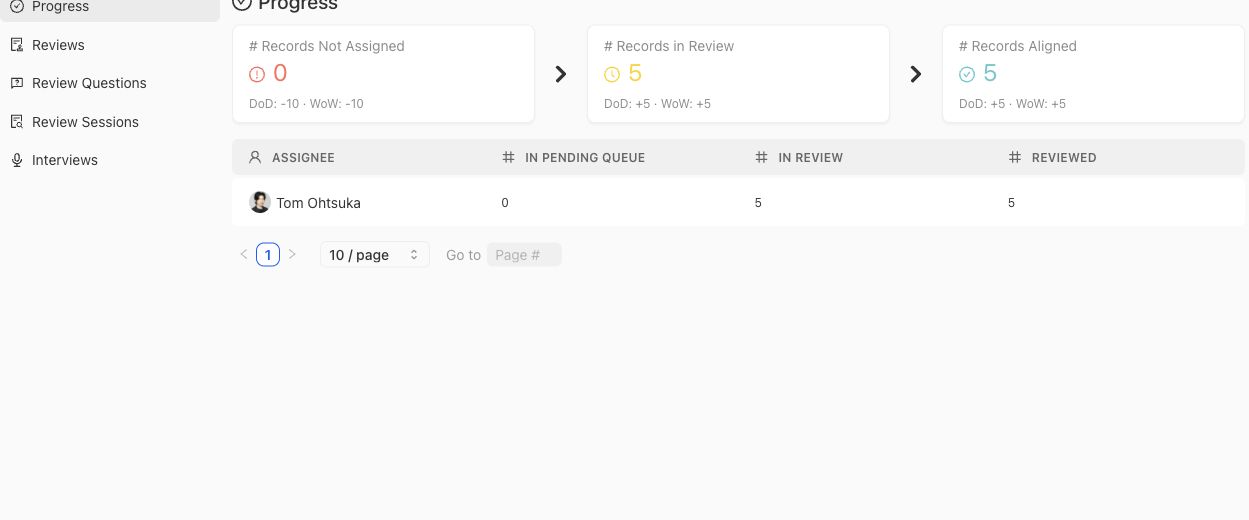
Use progress counts to locate work operationally; they do not establish whether contributed judgment was accepted.
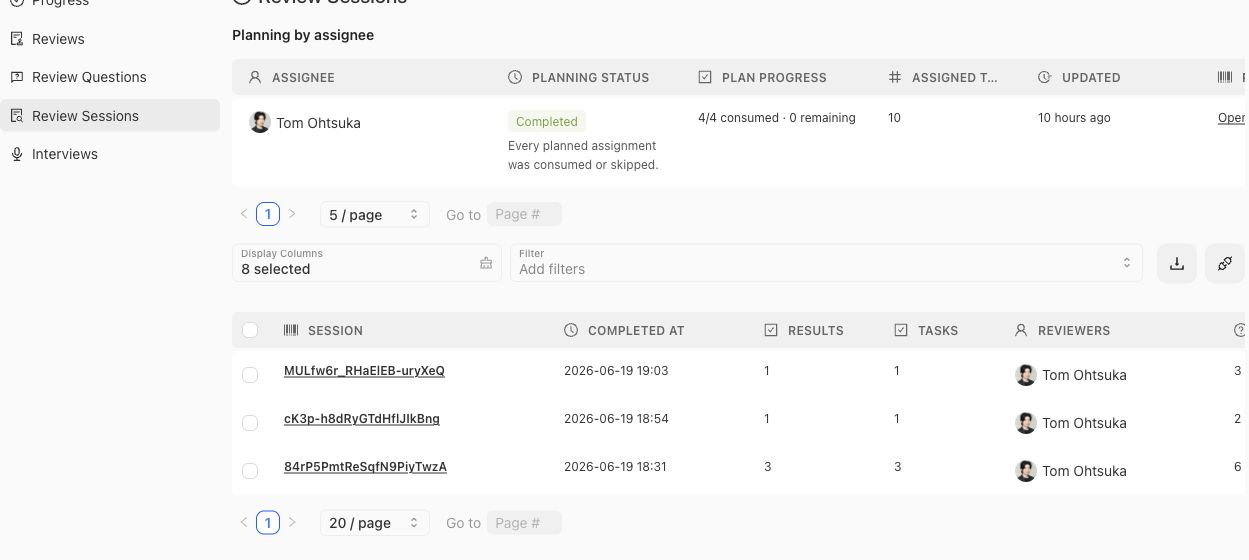
Open a session when you need its task and result provenance rather than inferring it from aggregate progress.
Filter and sort within the benchmark scope before comparing counts. A session, interview, review, and contributed artifact are separate objects and may have different completion times. Do not add their row counts together as a measure of unique Contributions or experts.
## Provenance and diagnosis
Start from the Contribution when explaining intent, then follow its planned activity to the session, review, interview, checkpoint, and materialized artifact. Transcript or response evidence may explain a decision, but the owning Policy, Rubric, Case, or coverage surface determines the artifact's current governance status.
When work appears stuck, compare durable status with the latest task or checkpoint rather than inferring from engagement alone. An expert can open a Contribution without completing a task, and a completed interview can still be waiting for checkpoint reconciliation or materialization.
> Operational evidence, not correctness proof
>
> Logs demonstrate activity and provenance. They do not prove that contributed content was accepted, that experts agreed, or that a candidate system passed an evaluation.
## Related task pages
{% related-card-grid title="Related task pages" %}
- [Request an Expert Contribution](/docs/expert-contributions/request-contribution)
- [Complete an Expert Contribution](/docs/expert-contributions/complete-contribution)
{% /related-card-grid %}
## Source confidence
Code-backed: the active Logs & Status routes define benchmark-scoped review, session, interview, and engagement tables and their detail surfaces.
---
id: expert-contributions.overview
title: Expert Contributions
summary: Coordinate benchmark-scoped expert work, attributable judgment, governed artifacts, and the decisions that move correctness forward.
kind: concept
product_area: expert_contributions
status: stable
updated: 2026-09-07
canonical: /docs/expert-contributions
---
# Expert Contributions
Expert Contributions is the benchmark-scoped workspace for requesting, conducting, and materializing specialist work. It coordinates the expert, objective, selected evidence, task sequence, checkpoints, attributable responses, and contributed artifacts needed to move a benchmark forward.
## Definition
The administrator workspace contains **Overview**, **Contributions**, **Contributed Artifacts**, and **Logs & Status**. **Request Contribution** opens the composer for a new contribution. The expert follows a contribution-specific experience that can contain form, chat, interview, and case-review tasks, along with checkpoints and completion states.
A Contribution is the unit of requested expert effort. It replaces broad workflow configuration with a bounded statement of what this benchmark needs from this expert now. The work can result in contributed policies, rubrics, cases, or coverage observations without flattening all expert activity into one generic approval record.
## Decision checkpoint
| Need | Contribution element | Result to inspect |
| --- | --- | --- |
| Resolve a specific benchmark question | Contribution statement and scoped objectives | The expert can explain the requested decision |
| Ground work in concrete behavior | Selected or designated cases | Case-level responses remain attributable |
| Supply supporting knowledge | Attachments and scoped statements | The expert sees the relevant source boundary |
| Choose the right interaction | Form, chat, interview, or case review task | Task output matches the kind of judgment needed |
| Confirm consequential learning | Checkpoint | Accepted, revised, or unresolved state is explicit |
| Reuse the result | Contributed Artifacts | Policies, rubrics, cases, and coverage observations retain provenance |
## Lifecycle and status
The durable Contribution statuses are `PREPARING_DIRECTION`, `AWAITING_DIRECTION_ALIGNMENT`, `MATERIALIZING_TASKS`, `READY`, `IN_PROGRESS`, `COMPLETED`, and `CANCELLED`. The interface presents these as planning direction, waiting for alignment, preparing tasks, ready, active, completed, or cancelled. The exact task sequence can vary by Contribution.
Realtime updates and durable transitions help the administrator and expert see current progress without inventing completion. A waiting state, checkpoint, or finalization step should be shown as such. Completing the expert experience does not imply that every proposed artifact has been accepted into its project-level owner.
## Contribution evidence
Logs & Status exposes operational and engagement records. Contributed Artifacts organizes materialized or contributed cases, policies, rubrics, and new coverage observations. Correctness Governance, Assets, or Coverage Management owns the resulting project or benchmark artifact after materialization.
This model improves return on expert effort. Agents prepare focused work from project context, indexed material, benchmark cases, and unresolved questions. The expert supplies the authority; the result can be reused across standards, coverage, evaluation, and improvement.
{% example-demo title="Resolve source authority" %}
A benchmark contains cases where an operational runbook conflicts with a newer policy page. The operator requests a Contribution from the policy owner, selects the conflicting cases, attaches both sources, and uses case review plus a checkpoint. The expert establishes which source controls, contributes a scoped policy and rubric, and records one coverage observation for an unrepresented exception.
{% /example-demo %}
## Related workflows
{% related-card-grid title="Related workflows" %}
- [Request an Expert Contribution](/docs/expert-contributions/request-contribution)
- [Complete an Expert Contribution](/docs/expert-contributions/complete-contribution)
- [Build policies and rubrics](/docs/operating-manual/build-policies-and-rubrics)
{% /related-card-grid %}
## Related reference pages
{% related-card-grid title="Related reference pages" %}
- [Contributed Artifacts](/docs/expert-contributions/contributed-artifacts)
- [Contribution lifecycle and status](/docs/expert-contributions/lifecycle-and-status)
- [Logs & Status](/docs/expert-contributions/logs-and-status)
- [Agent Setup](/docs/agent-setup)
- [Human Approval Boundaries](/docs/governance/human-approval-boundaries)
{% /related-card-grid %}
## Source confidence
Code-backed: the active benchmark workspace, Contribution dashboard, composer, administrator detail, and expert routes support the scope, task, status, and artifact model described here.
---
id: expert-contributions.lifecycle
title: Contribution Lifecycle and Status
summary: Interpret Contribution, activity, task, expert-runtime, and checkpoint states without inferring completion.
kind: reference
product_area: expert_contributions
status: stable
updated: 2026-08-22
canonical: /docs/expert-contributions/lifecycle-and-status
---
# Contribution Lifecycle and Status
## Definition
Contribution status, task status, expert-runtime state, and checkpoint state describe different layers. Read them together before diagnosing delay or declaring completion.
## Fields, states, or lifecycle rules
### Contribution status
| Status | Meaning |
| --- | --- |
| `PREPARING_DIRECTION` | Teammately is planning the direction and requested work |
| `AWAITING_DIRECTION_ALIGNMENT` | An administrator decision or alignment is required |
| `MATERIALIZING_TASKS` | The confirmed plan is becoming executable expert activities |
| `READY` | Work is prepared and available to the expert |
| `IN_PROGRESS` | At least part of the expert work is active |
| `COMPLETED` | Required expert work and finalization reached the durable terminal state |
| `CANCELLED` | Further work was stopped while preserving the record |
Planned activities can be Case Review, Form, Chat, or Interview. An individual review task can be preparing, blocked, ready, in progress, completed, skipped, or superseded. A superseded task remains provenance for what changed; it should not be counted as current outstanding work.
### Runtime and checkpoints
The expert runtime moves through preparing, ready, active, final checkpoint, completed, or exhausted. `EXHAUSTED` means the current executable path has no further work; it is not a synonym for a successfully completed Contribution.
A checkpoint moves from preparing to ready to reconciled. Its requirements may be pending, retryable, materialized, terminal-empty, or failed. Checkpoints can consolidate requirements, capture Policy meaning, prepare or record an Interview, or materialize Rubric meaning. A ready checkpoint still needs the expert's reconciliation.
### Diagnosing state
If the Contribution is `IN_PROGRESS` but the expert sees no action, inspect the current task, runtime, and checkpoint. A blocked task may be waiting for evidence; a final checkpoint may need confirmation; an exhausted runtime may require administrator follow-up. Use Logs & Status for durable timing and engagement evidence rather than relying on a stale open browser view.
> Completion boundary
>
> `COMPLETED` makes contributed evidence available for downstream governance. It does not automatically approve a Policy or Rubric, select a Case into a benchmark, or apply a coverage observation.
## Related task pages
{% related-card-grid title="Related task pages" %}
- [Request an Expert Contribution](/docs/expert-contributions/request-contribution)
- [Complete an Expert Contribution](/docs/expert-contributions/complete-contribution)
{% /related-card-grid %}
## Source confidence
Code-backed: administrator and expert runtime sources define the layered Contribution, task, runtime, checkpoint, and requirement states described here.
---
id: expert-contributions.artifacts
title: Contributed Artifacts
summary: Inspect policies, rubrics, cases, and coverage observations produced through attributable expert contribution work.
kind: reference
product_area: expert_contributions
status: stable
updated: 2026-09-07
canonical: /docs/expert-contributions/contributed-artifacts
---
# Contributed Artifacts
## Definition
Contributed Artifacts is the benchmark workspace for inspecting durable material produced through Expert Contributions. It organizes contributed **Policies**, **Rubrics**, **Cases**, and **new coverage observations** while preserving their relationship to the Contribution and expert work that produced them.
The view is a provenance and reconciliation surface. The final owner of a materialized artifact remains Correctness Governance, Assets, or Coverage Management according to artifact type.
## Fields, states, or lifecycle rules
- Policy contributions represent expert-grounded behavior rules or revisions.
- Rubric contributions represent proposed or accepted evaluation criteria tied to specialist judgment.
- Case contributions represent situations supplied or corrected through expert work.
- Coverage observations identify missing, thin, conflicting, or newly important benchmark behavior.
- A coverage observation preserves its source, proposed facet applications, and application status so an operator can distinguish a recorded observation from one incorporated into coverage structure.
- Each artifact should remain traceable to the Contribution, expert, selected evidence, task responses, and checkpoints that support it.
- Contribution completion and artifact governance are separate transitions. Inspect the artifact's owning surface before treating it as active policy, active rubric, benchmark dataset membership, or resolved coverage.
- Reconciliation can accept, revise, route, or leave material unresolved according to the active workflow.
## Interpreting contributed material
Use the artifact type to choose the next surface. A contributed policy or rubric belongs in Correctness Governance. A contributed case belongs in the project Assets pool before benchmark selection. A coverage observation belongs in Coverage Management and may motivate a Coverage Story, case construction, or another focused Contribution.
Preserve disagreements. Two experts can contribute conflicting Policy interpretations, and the artifact view should help an operator trace each interpretation rather than merge them into an invented consensus. Materialization should keep the Contribution, activity, checkpoint, expert, and scoped evidence links needed to explain why the artifact exists.
{% example-demo title="Example: contribution provenance" %}
An expert contributes a policy limiting compatibility claims, a rubric for explicit uncertainty, and a new case involving an unsupported adapter. The policy and rubric move to Correctness Governance for their lifecycle. The case enters Assets and is later selected into a benchmark dataset snapshot. All three retain the Contribution as their provenance.
{% /example-demo %}
## Source confidence
Code-backed: the active Contributed Artifacts workspace exposes policy, rubric, case, and new-coverage groupings. This page preserves the separation between contribution provenance and the lifecycle of each owning artifact.
## Related task pages
{% related-card-grid title="Related task pages" %}
- [Request an Expert Contribution](/docs/expert-contributions/request-contribution)
- [Complete an Expert Contribution](/docs/expert-contributions/complete-contribution)
- [Build policies and rubrics](/docs/operating-manual/build-policies-and-rubrics)
{% /related-card-grid %}